Publications, training and tools from SEUS
By January 2026, the SEUS project had carried out 25 conference participations and 142 outreach activities — news articles, talks, workshops and scientific presentations. Results are shared through FAIR-aligned tools like GitHub and Zenodo, as well as social media.
A Smart Shipbuilding Framework for Europe's shipyards
SEUS is a Horizon Europe Innovation Action (grant No. 101096224, 2023–2027) coordinated by NTNU, building an integrated digital platform that connects CAE, CAD, CAM and PDM/PLM tools for European shipyards.
Work packages, deliverables and the coordinators responsible for each are listed on NTNU's Work Packages and Deliverables page.
Smarter use of computational tools
Digitalization and computational tools have great potential to generate value for improving the competitiveness of the EU shipbuilding industry. It requires a significant reshaping of existing tools and practices to be exploited successfully — the gains come as increased quality and reduced time for design and virtual prototyping, better estimates of the impact of greening technologies, modularization, flexible data management, interoperability across proprietary tools, cybersecurity, efficient support for modern robotized fabrication, and openness for integration with operational platforms.
The purpose of SEUS
SEUS is building a Smart Shipbuilding Framework: an integrated platform combining CAE, CAD, CAM and PDM software into one solution, tested directly at partner shipyards. Alongside it, the project develops human-centric knowledge-management practices and explores NLP and data-driven AI within an Industry 5.0 approach to shipbuilding.
Innovation in action
The project targets process innovation across the shipbuilding value chain: open standards and interfaces for shipbuilding data, AI-assisted routines, CAD/CAE/CAM integration through a smart PDM platform, 2D–3D modularization and data reuse, and closing the lifecycle loop with maintenance and operations (MRO). The ambition is real time and cost savings in engineering, assembly and construction at European shipyards.
Why shipbuilding needs this
European shipbuilding is fragmented, document-heavy, and lags behind automotive and aerospace in digitalization.
Ship models can contain 2–3 million elements, and current CAD/CAE/CAM/PDM/ERP tools don't share data well — causing rework, coordination overhead, and slow early-stage design.
Up to roughly 8% of production time at a shipyard can go to coordination activities alone.
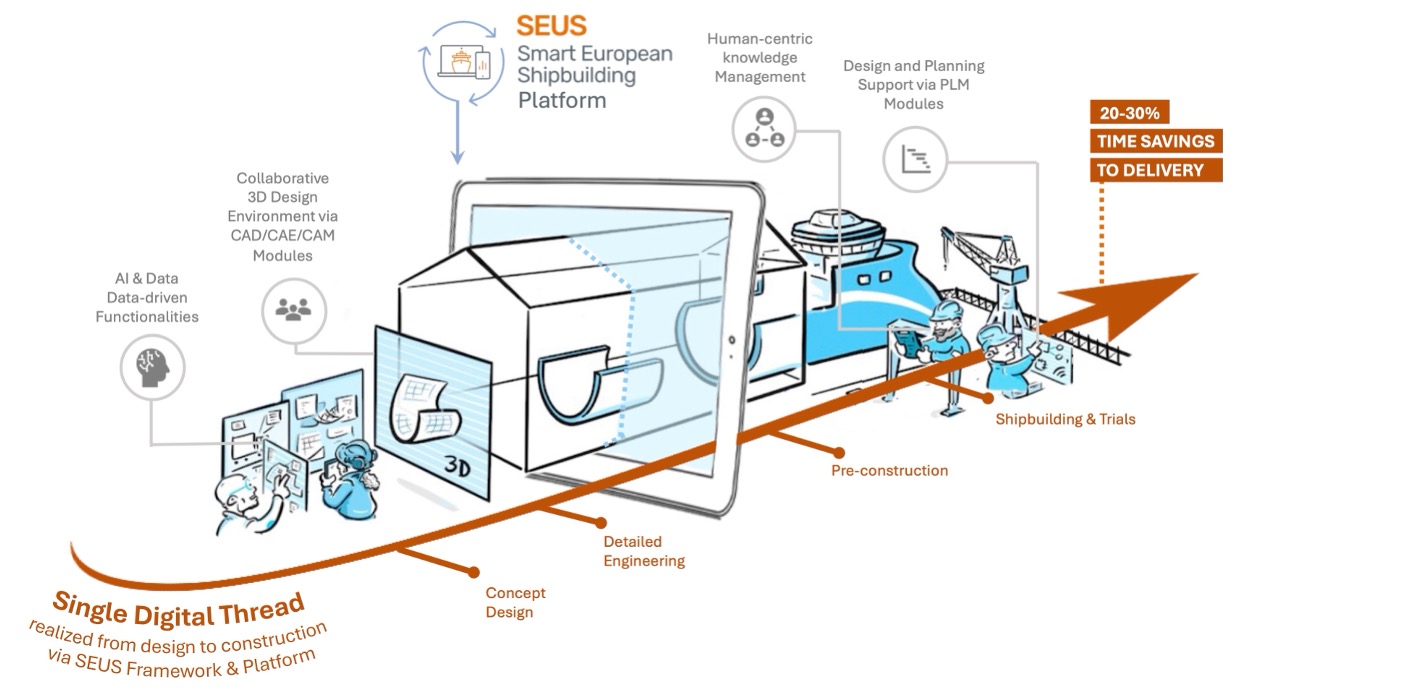
There's no shared "digital thread" connecting design, engineering, construction and maintenance/operation.
Seven objectives guiding the project
- Map shipbuilding workflows and use cases through an Industry 5.0 lens.
- Strengthen human-centric competitiveness, reflecting the needs of workers, shipowners, operators and other stakeholders.
- Build a shipbuilding-specific PLM platform integrating CAE, CAD, CAM and PDM elements.
- Make the platform flexible enough to support multiple workflows, rapid early design, AI tooling and virtual prototyping.
- Ensure openness, interoperability and cybersecurity.
- Pilot and test the platform in real industrial (shipyard) settings — the “digital shipyard” concept.
- Quantify the value created and build a business / exploitation model.
The expected impact
The ambition is up to 30% time-saving in engineering and up to 20% time-saving in assembly and construction at European shipyards, by closing gaps in digital information flows and optimising work processes.
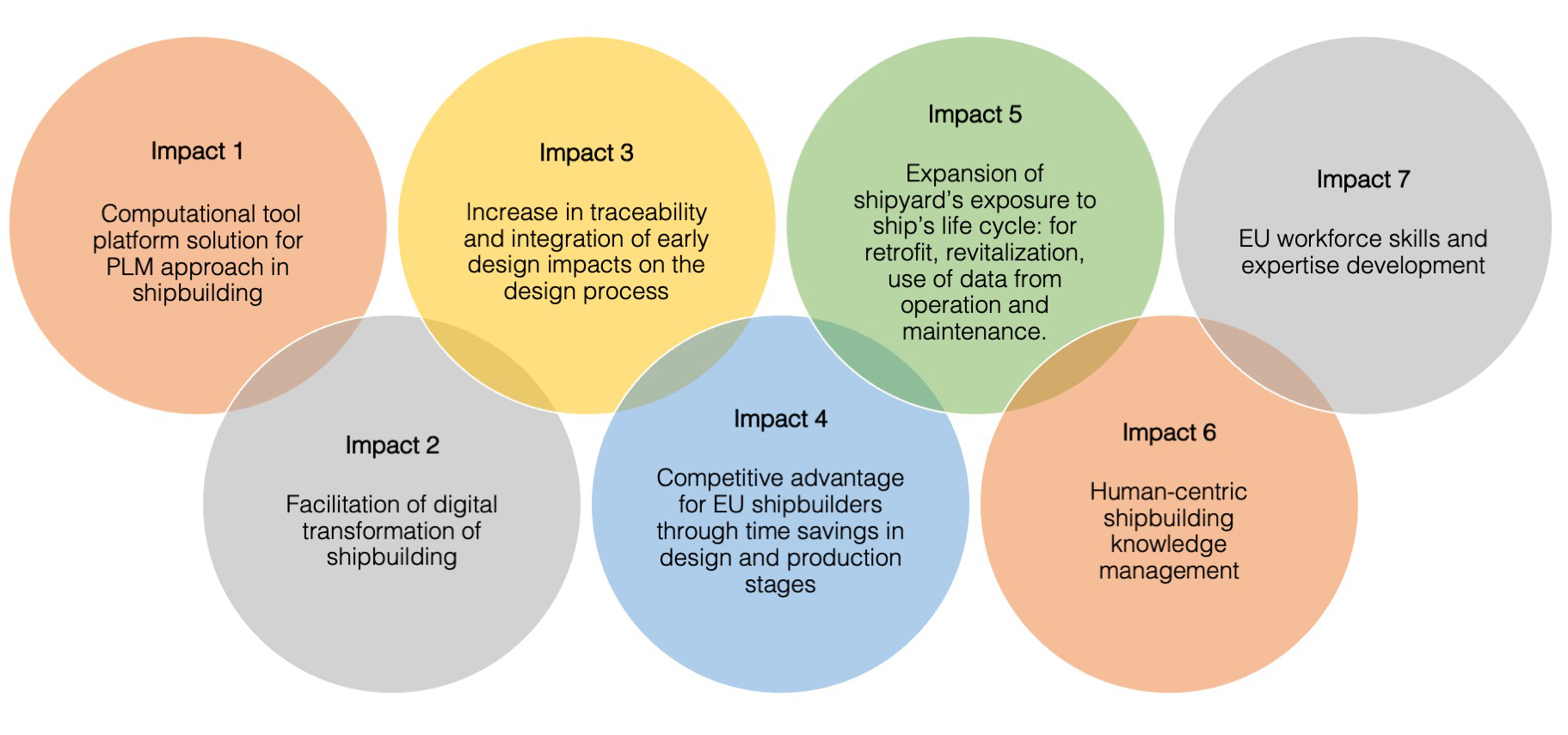
Impact 1: Computational platform solution for PLM approach in shipbuilding
A shipbuilding-specific PLM platform, with interoperability, a standardized data model and process-management tools, tested in a real shipyard with a direct feedback loop — including a business model for commercial exploitation as PaaS or SaaS.
Impact 2: Facilitation of digital transformation of shipbuilding
Higher digitalization levels support resource-efficient designs, tools to evaluate design impact at the virtual-prototyping stage, a human-centric approach to digital shipbuilding processes, and up-skilling European shipbuilders.
Impact 3: Traceability and integration of early design impact on the design process
An interconnected digital thread gives traceability of decisions and impacts and simplifies early-stage design for naval architects, designers, engineers, shipyards and shipowners — raising gross margins by better analysing and justifying cost changes.
Impact 4: Competitive advantage for EU shipbuilders through time savings in design and production
Faster communication and design-to-production data transfer shorten lead times — one of the strengths eroded by Asian competitors in recent years — letting shipyards build more ships and reduce indirect and financing costs.
Impact 5: Expansion of shipyards’ exposure to a ship’s life cycle
Insight from a vessel's operation and maintenance stage feeds back into design evaluation, retains customer relationships into the operational stage, and supports testing, simulation and training for emission-reduction technologies.
Impact 6: Human-centric shipbuilding knowledge management
Values, interaction, collaboration and skill development are studied to improve the effectiveness and productivity of a highly skilled workforce, including lifecycle-integrated training and learning programmes for shipbuilding stakeholders.
Impact 7: EU workforce skills and expertise development
A single source of truth for everyone involved in a shipbuilding project, with audience-specific UX and controlled access to data, giving the context needed for everyday tasks and boosting digital skills across the EU workforce.
Four phases
1. Shipbuilding Best Practices
Research the current state of digitalisation and human-centred, Industry 5.0 needs across European shipbuilding.
2. Smart Shipbuilding PLM Platform
Core software development, integrating CAE/CAD/CAM/PDM modules and shipbuilding expertise into one open platform.
3. Shipyard Implementation
Pilot the platform at partner shipyards and gather feedback.
4. Business & Innovation
Quantify the value created and build exploitation and dissemination plans.
Seven work packages, 39 deliverables
The SEUS project is structured into seven work packages, together comprising 39 deliverables. Each work package contributes to the project's overall objective — developing a new computational toolset — while addressing user needs, technology advances, platform interoperability, a human-centric approach, and the project management and dissemination that support all of it.
Best Practices in Shipbuilding
Lead: NTNU
Research, evaluate and compile best practices for the smart PLM approach in shipbuilding — building a new body of knowledge for the value shipbuilding can gain from digitalisation and a single-source-of-truth approach to data sharing.
4 deliverables
- D1.1 — Results and Analysis of the Best Practices Research
- D1.2 — Results and Analysis of the Survey
- D1.3 — Strategic Roadmap for Development (CADMATIC)
- D1.4 — Framework Compilation
CAD + PLM Platform Development
Lead: CADMATIC
The core software build: developing the integrated platform using input from WP1 and WP5, closely linked with WP3 and WP4, in cooperation with all consortium participants.
5 deliverables
- D2.1 — Roadmap and development backlogs
- D2.2 — Data model structure and mapping
- D2.3 — Software version releases
- D2.4 — Documentation for workflows
- D2.5 — Generic Data Model for Shipbuilding Projects
Open Platform Development
Lead: CONTACT / CADMATIC / NHL Stenden
Ensure the platform's compatibility with the main proprietary systems (CAE, CAD, CAM, PDM, MES) used in commercial shipbuilding, support ship-operation data via standardised protocols, and support Industry 5.0 principles.
7 deliverables
- D3.1 — CAD interoperability interface (CADMATIC)
- D3.2 — PDM/PLM API interfaces (CONTACT)
- D3.3 — Platform capabilities for automated, interconnected AI services (CONTACT)
- D3.4 — PDM/ERP interface (CONTACT)
- D3.5 — PDM/MES interface with standardised data exchange (CONTACT)
- D3.6 — PLM/IoT interfaces for ship operation data (CONTACT)
- D3.7 — Cyber security governance (NHL Stenden)
Implementation at Shipyards
Lead: Ulstein
Implement intermediate and final versions of the platform at the shipyards, test it in selected use cases, gain insight into fit with shipyard processes, and feed findings back into development.
5 deliverables
- D4.1 — Use cases selected (Ulstein)
- D4.2 — List of participants in use cases, by department and role (Ulstein)
- D4.3 — Training material and training plan for use-case participants (CADMATIC)
- D4.4 — Implementation data (Ulstein)
- D4.5 — Analysis of findings and feedback (Ulstein)
Knowledge Management & Skills Development
Lead: University of Turku
Human-centric representation and management of shipbuilding activities, including AI-based document intelligence, knowledge-management tooling, and skills / training development for shipbuilding actors.
5 deliverables
- D5.1 — Knowledge Management System
- D5.2 — Series of information retrieval tools
- D5.3 — Smart Shipbuilding Activity Map System
- D5.4 — Business model support system
- D5.5 — Learning technology-based training
Communication & Dissemination
Lead: NTNU / CADMATIC
Assure the project's visibility and spread information on its goals, activities and results to relevant stakeholders and scientific communities, and manage the project's Intellectual Property Rights.
7 deliverables
- D6.1 — Repository of commercially usable communication material (NTNU)
- D6.2 — Customer-oriented commercial material from software suppliers (CADMATIC)
- D6.3 — Website (NTNU)
- D6.4 — IP management and exploitation rules and agreements (CADMATIC)
- D6.5 — Training material (CADMATIC)
- D6.6 — Plan for Exploitation, Dissemination and Communication of results (NTNU)
- D6.7 — Updated plan for Exploitation, Dissemination and Communication of results (NTNU)
Project Management
Lead: NTNU
Ensure smooth cooperation among consortium partners, lead the consortium towards its goals, manage finance/technical/legal matters, and coordinate with the EC project officer.
6 deliverables
- D7.1 — Management and Quality Plan
- D7.2 — Risk Management Plan
- D7.3 — Initial Data Management Plan
- D7.4 — First update to the DMP
- D7.5 — Second update to the DMP
- D7.6 — Final DMP
Seeing the whole system at once
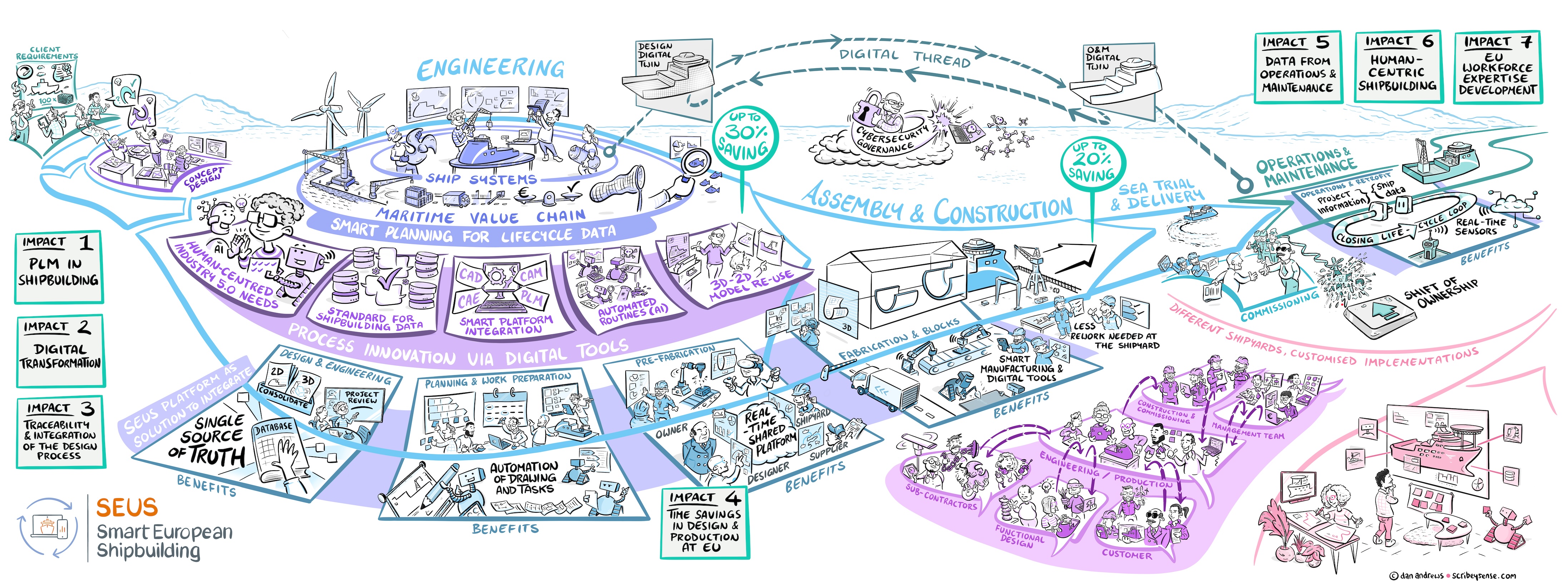
Early in the project the consortium sketched a "rich picture" — a systems-thinking overview mapping the people, tools, data flows and pain points across the shipbuilding value chain, from design offices to the shipyard floor.
Curious who's behind SEUS?
Eight partners across five countries — researchers, software developers and shipyards.
Annual Reports
2025 Annual Report (PDF)
Earlier reports (2023, 2024) are available via the project archive.
Open repository
Publications and datasets are shared on Zenodo. Project code: GitHub, September 2024 release referenced at doi.org/10.5281/zenodo.13834386.
Social media
Follow SEUS — Smart European Shipbuilding on LinkedIn for the latest updates — see the Media & Events page for the live feed.
44 publications and counting
Newest first within each year. A full PDF list is also updated periodically on the project archive.
2026
-
Product Lifecycle Management in Engineering-to-Order: Adoption Challenges in EU Shipbuilding
2025
-
Design-Based Research for User-Centered Digital Industrial Training
-
Promoting Digitalization Competences in Project-Based Firms: Design and Testing of a Digital Learning Solution
2024
2023
Free training on data-driven shipbuilding
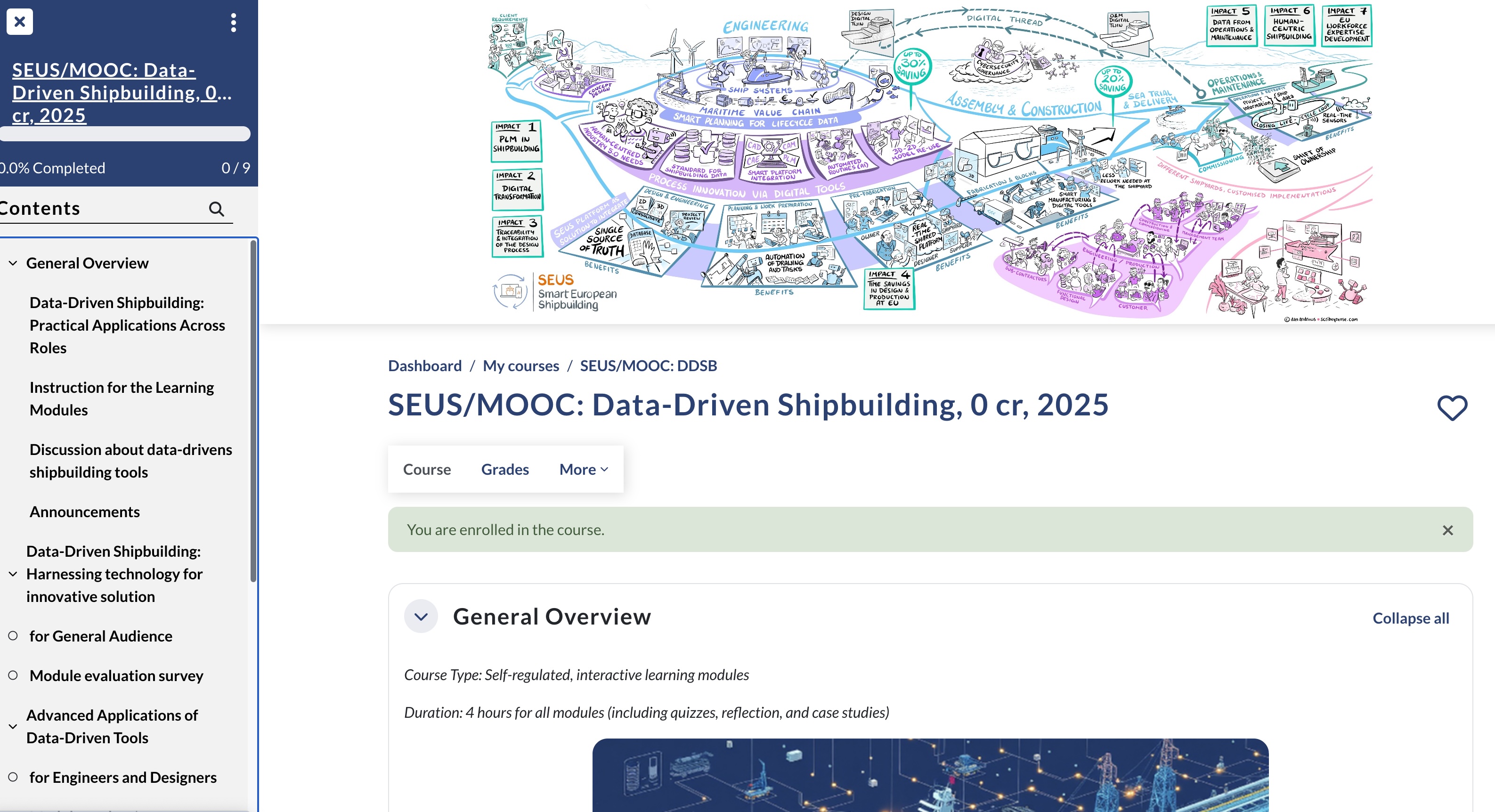
In September 2025, the SEUS project released the pilot of the Data-Driven Shipbuilding learning solution, developed by the University of Turku's researchers in industrial engineering and management, in collaboration with the international SEUS team. The training is available on the DigiCampus platform, designed for practitioners and shipbuilding students.
The learning solution includes short digital modules for engineers, designers, supervisors and managers across the shipbuilding industry. Each participant can explore the modules most relevant to their role — there's no requirement to complete the entire course. Upon completing a module you can download a personalised certificate of completion.
To access the course: log in to DigiCampus using your Google account (or a Finnish university account), search for “SEUS/MOOC: Data-Driven Shipbuilding”, and enrol using the key SEUS-Learning.
Contact: Professor Miia Martinsuo (miia.martinsuo@utu.fi) · Post-doctoral researcher Zeynep Tacgin (zeynep.tacginsimsek@utu.fi), University of Turku, Industrial Engineering and Management.
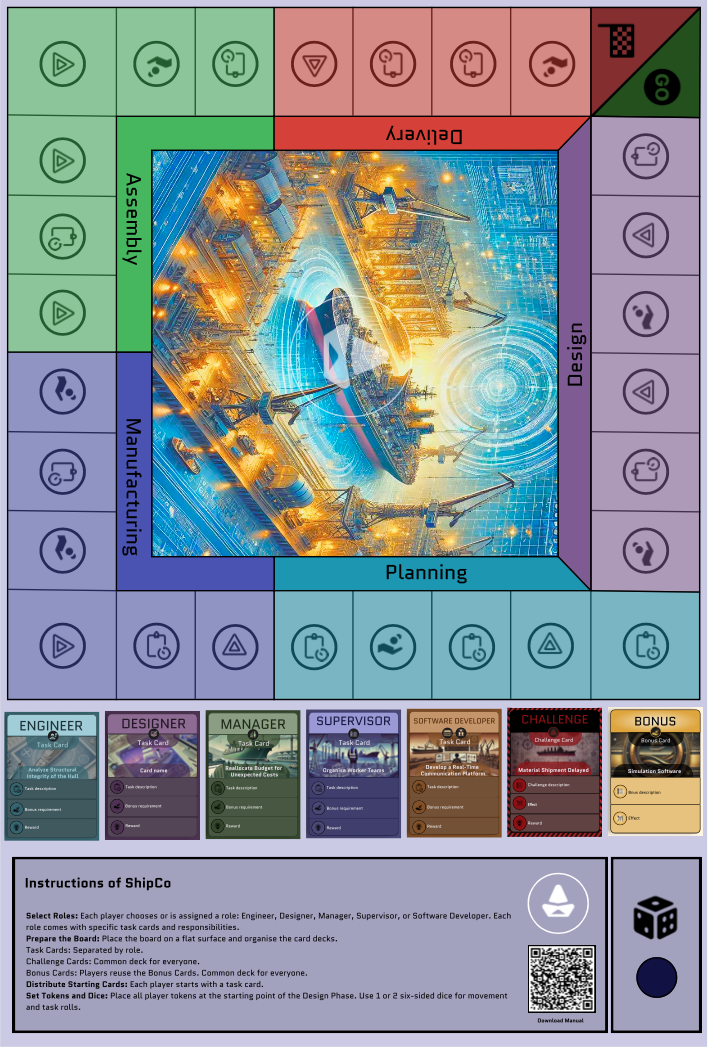
Learning shipbuilding digitalisation, one turn at a time
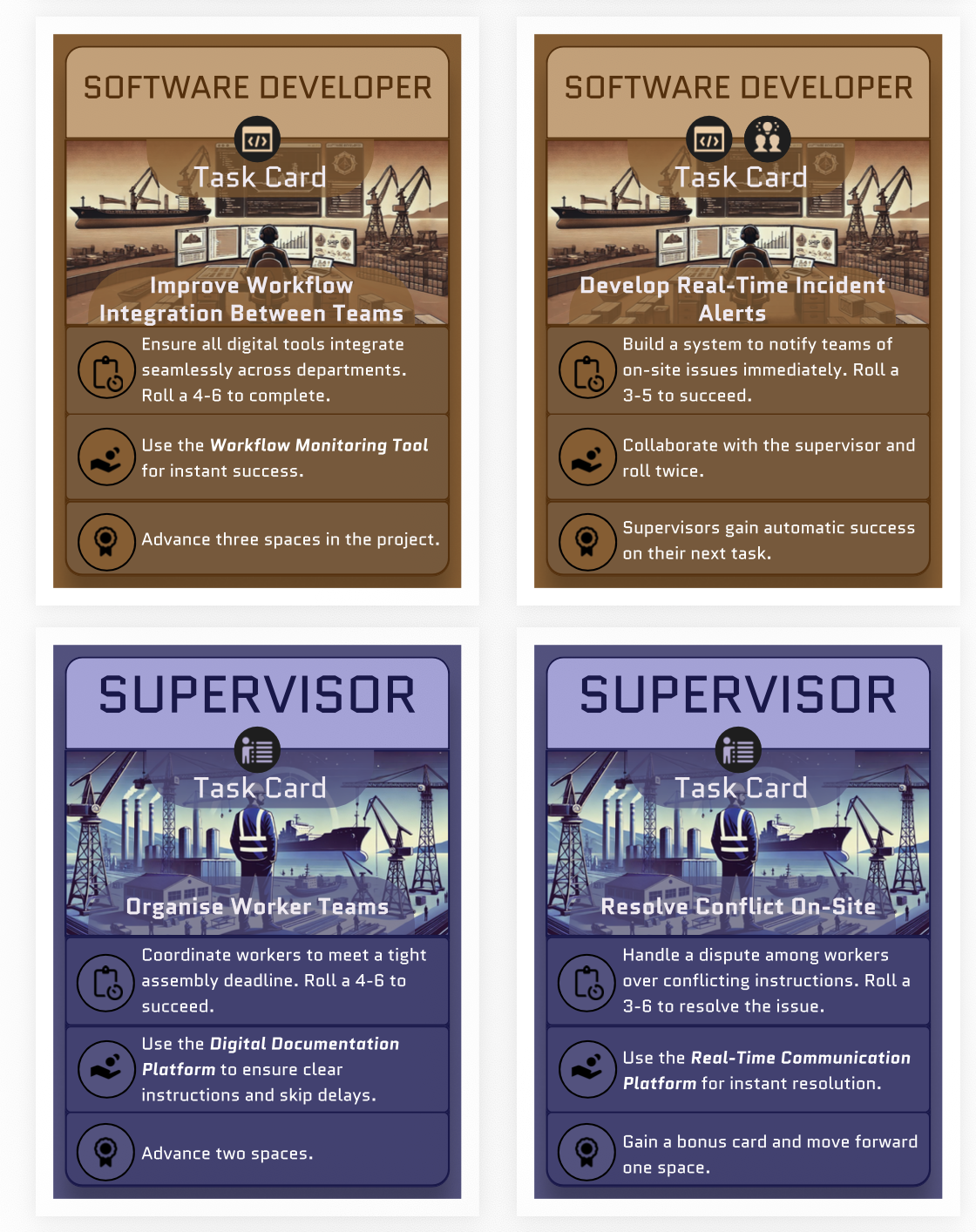
ShipCo is a board game developed by researchers Zeynep Tacgin and Miia Martinsuo at the University of Turku, as part of learning-technology-based training in SEUS. The game encourages the adoption of digital solutions and builds readiness for data-driven shipbuilding. See the Scientific Publications section for the related research (Tacgin & Martinsuo, 2025).
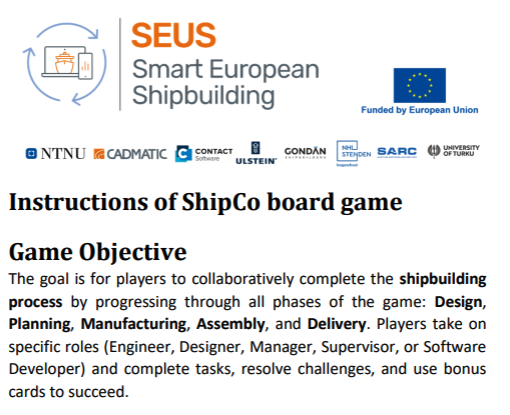
Game objective: players recognise the potential of using digital data and collaboratively complete the shipbuilding process by progressing through all phases of the game — Design, Planning, Manufacturing, Assembly and Delivery. Players take on roles such as Engineer, Designer, Manager, Supervisor or Software Developer, complete tasks, resolve challenges, and use bonus cards to succeed.
Game materials (board, cards, card backs and instructions) are available from the project team — get in touch for a copy.